GPRNK Index
A monthly index of geopolitical risk from North Korea, measured from South Korean news coverage — 1995 to 2025. Free to download and use with attribution.
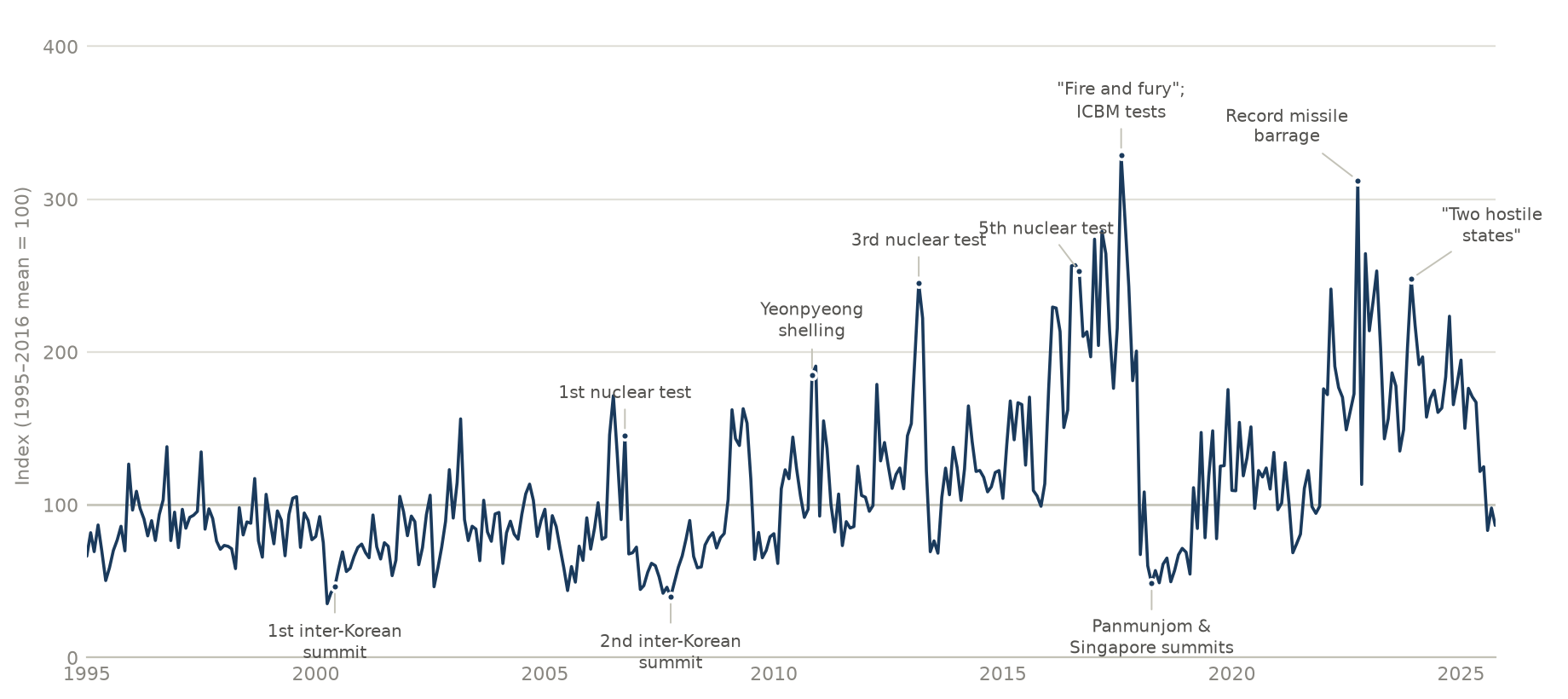
The GPRNK index tracks how strongly inter-Korean relations lean toward confrontation rather than engagement in any given month. It is built from article counts in 18 South Korean newspapers and broadcasters, grouped into two negative categories (military tensions, sanctions) and two positive ones (talks and agreements, economic cooperation). The index rises around nuclear tests, missile launches and armed clashes, and falls around summits and periods of engagement. It was constructed for Lee, Lee and Jung (2026), which uses it to show that heightened geopolitical risk reduces corporate investment by South Korean firms.
The index
Monthly GPRNK index, normalised to a mean of 100 over 1995–2016. Marked months are reference events; hover or use the arrow keys to read individual values.
Show the data as a table
Download
Both files carry the same nine columns and 370 monthly observations. The Excel workbook adds a Notes sheet with the column definitions, source and citation.
Variables
| Column | Definition |
|---|---|
date | Month, dated to the first day (YYYY-MM-DD). |
gprnk | The headline index: the net share of negative North Korea–related articles, standardised within outlet over 1995–2016, averaged across outlets, then normalised to a mean of 100 over the same period. |
gprnk_negative | Negative component — military tensions and sanctions. |
gprnk_positive | Positive component — talks/agreements and economic cooperation. |
threat | Subtopic index: military tensions (nuclear, missile, war, provocation). |
sanction | Subtopic index: sanctions and external pressure. |
talks | Subtopic index: talks, dialogue, negotiations and agreements. |
economic_cooperation | Subtopic index: inter-Korean economic cooperation. |
gprnk_raw | GPRNK-raw: the same searches without excluding negation terms. Correlation with gprnk: 0.98. |
How the index is built
News articles are retrieved from BigKinds, the news archive of the Korea Press Foundation, covering 18 major South Korean outlets — ten national daily newspapers, five business and economics dailies, and the three national broadcasters. Between them they account for 68.9% of national newspaper circulation and 63.6% of national broadcast viewership. Coverage is restricted to politics, economics and international relations. Within all North Korea–related articles, four keyword categories are counted: military tensions, sanctions, talks/agreements and economic cooperation. Articles containing category-specific negation terms are excluded, so that a story reporting the opposite of an event is not counted as that event.
For each outlet and month, the index takes the difference between the shares of negative and positive articles, standardises it by that outlet’s own standard deviation over 1995–2016, averages across outlets, and normalises the result to a mean of 100 over the same base period. Indices built separately from right- and left-leaning newspapers move closely together (correlation 0.94), so the series is not an artefact of editorial slant. The index is North Korea–specific by construction: its correlation with the Korea GPR index of Caldara and Iacoviello (2022), which measures globally salient geopolitical risk, is only 0.33.
Full construction details are in Appendix A.1 of the paper, and at greater length in IMF Working Paper 2021/251, which documents the search keywords, the outlet list and the robustness checks for an earlier vintage of the index.
Citation
Please cite the paper when you use the index:
@article{lee2026corporate,
  author  = {Lee, Jongmin and Lee, Seohyun and Jung, Seungho},
  title   = {Corporate Investment Under North Korea Threats},
  journal = {Applied Economics Letters},
  year    = {2026},
  pages   = {1--8},
  doi     = {10.1080/13504851.2026.2731151}
}
The data files are released under CC BY 4.0: you may share and adapt them, including commercially, provided you give credit. An earlier version of the index appears in Jung, Lee and Lee (2021), IMF Working Paper 2021/251; the series published here is the current one.
Updates
| Release | Coverage | Notes |
|---|---|---|
| 2026-09 | 1995-01 – 2025-10 | First public release: headline index, components, four subtopics, and GPRNK-raw. |
The index is extended periodically. Questions, or a use you would like to tell us about: shjung@inu.ac.kr.