Seungho Jung
Seungho Jung
정승호
Associate Professor, International Business Economics (IBE)
School of Northeast Asian Studies, Incheon National University
인천대학교 동북아국제통상물류학부 부교수
Office 327, Building 14C · 119 Academy-ro, Yeonsu-gu, Incheon, Korea
Tel: +82-32-835-8726 · shjung@inu.ac.kr · shjpeace@gmail.com

About

I am an Associate Professor of International Business Economics at Incheon National University, where I study the North Korean economy using empirical methods. Before joining INU in 2019 I was an economist at the Economic Research Institute of the Bank of Korea, and earlier a researcher at the Korea Institute for International Economic Policy (KIEP).

My work runs along four lines: the domestic North Korean economy and its marketization; foreign economic relations with China and Russia; unification, inter-Korean geopolitical risk and economic integration; and the economic adaptation of North Korean refugees in South Korea. Much of it is a measurement problem — official statistics on North Korea are scarce, so I build indices from news text, work with administrative big data, and use cohort and panel designs to get at questions that direct data cannot answer. See Research for current projects and Publications for the full list.

인천대학교 동북아국제통상물류학부에서 북한경제, 북·중·러 대외경제관계, 통일과 경제통합, 북한이탈주민의 경제적 적응을 연구합니다.

Featured Data

Two datasets on the North Korean economy, free to download with attribution. See all data →
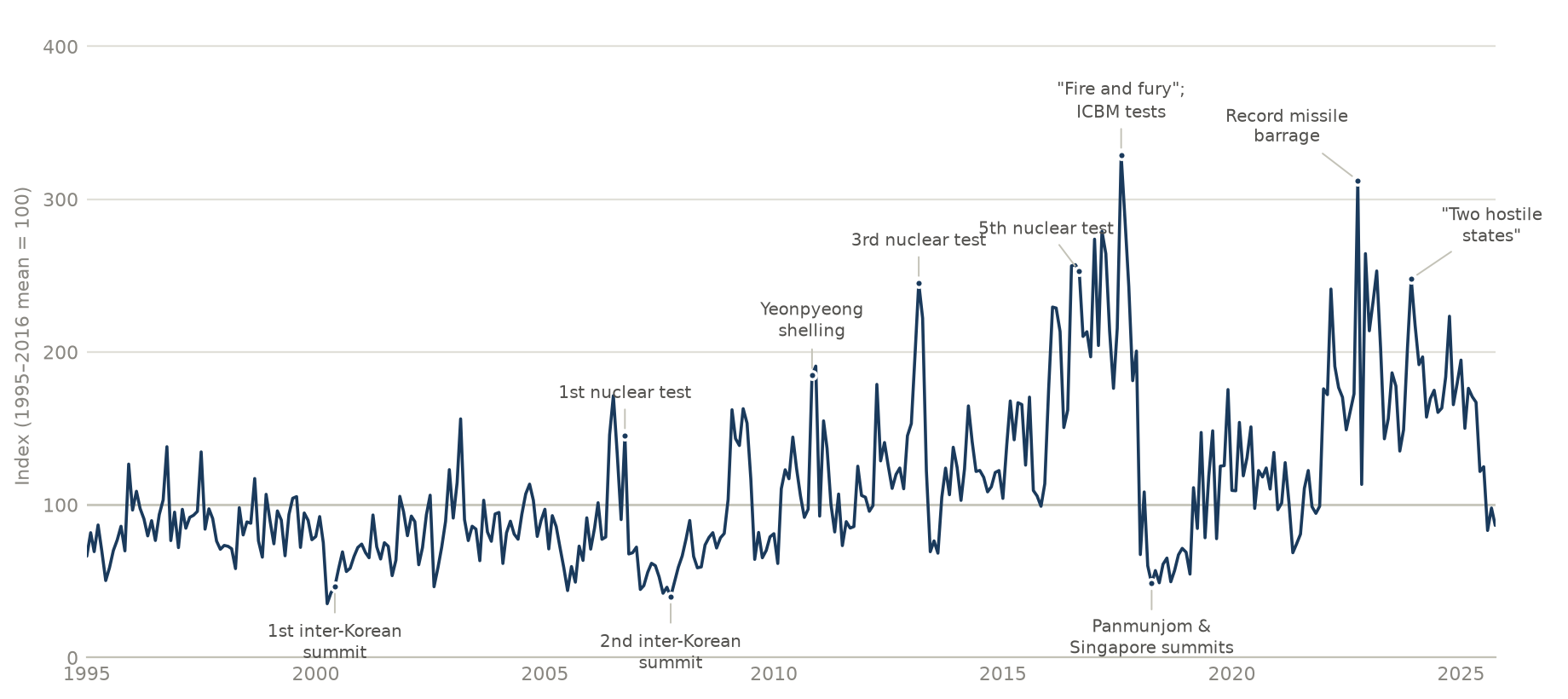
Line chart of the monthly GPRNK index from 1995 to 2025, rising around nuclear tests and missile launches and falling around inter-Korean summits.

The GPRNK index, 1995–2025. A monthly measure of geopolitical risk from North Korea, built from article counts in 18 South Korean news outlets: it rises around nuclear tests and military confrontations and falls around summits. Constructed for Lee, Lee and Jung (2026), Applied Economics Letters. Explore and download the data →

Line chart of North Korean marketization across five periods to 2020: price liberalization rising to 2.91, privatization climbing steadily to 1.09, and financial development almost flat at 0.28.

The North Korean marketization index, 1990s–2020. Price liberalization, privatization and financial development. Each score is a share of respondents rescaled to run 0–5, so 2.91 means about 58% describe market pricing and 1.09 means 22% report private ownership. Privatization rises without pause — fastest in 2016–2020, the years of the heaviest sanctions — while price liberalization flattens and finance stays near the floor. Rebuilt from public survey data using the method of Jung, Yang and Kim (2022), Asian Perspective. Explore and download the data →

Recent News

2026.09
The North Korean marketization index is now available for download — price liberalization, privatization and financial development across five periods to 2020, built from the Ministry of Unification’s published survey.
2026.09
The GPRNK index is now available for download — monthly data from 1995 to 2025, with negative/positive components and four subtopic series (with Jongmin Lee and Seohyun Lee).
2026.09
New peer-reviewed article: "Corporate Investment Under North Korea Threats"Applied Economics Letters, 1–8 (with Jongmin Lee and Seohyun Lee).
2026.09
New peer-reviewed article: "Health Status and Economic Assimilation of North Korean Defectors in South Korea"Asian Perspective 50(3), 583–610 (with Jongmin Lee and Hyeseung Wee).
2026.08
Seminar presentation at the Bank of Korea: "Explaining Declining Unification Support: Cohort Persistence and Labor-Market Competition in South Korea" (with Youngshin Cho and Kyoochul Kim).
2026.05
New webzine article: "부진한 북·중 인적교류, 러시아가 대신하는가?" — 인천대학교 중국학술원 웹진 관행중국 Vol.188 (정승호·이현태 공저).
2026.04
New peer-reviewed article: "러우 전쟁 이후 북러관계 강화가 북중경제협력에 미치는 영향 분석"동북아경제연구 38(1), 151–190 (정승호·이현태 공저).
2026.04
New commentary: "Assessment of North Korea's 9th Party Congress Economic Plan: Background to the Adopting a Management-Oriented Plan Despite the Declaration of Success in the 8th-Term" — Global NK.
2026.04
New commentary: "북한 제9차 당대회 경제계획 평가: 8기 성공 선언에도 관리형 계획을 채택한 배경"동아시아연구원.